
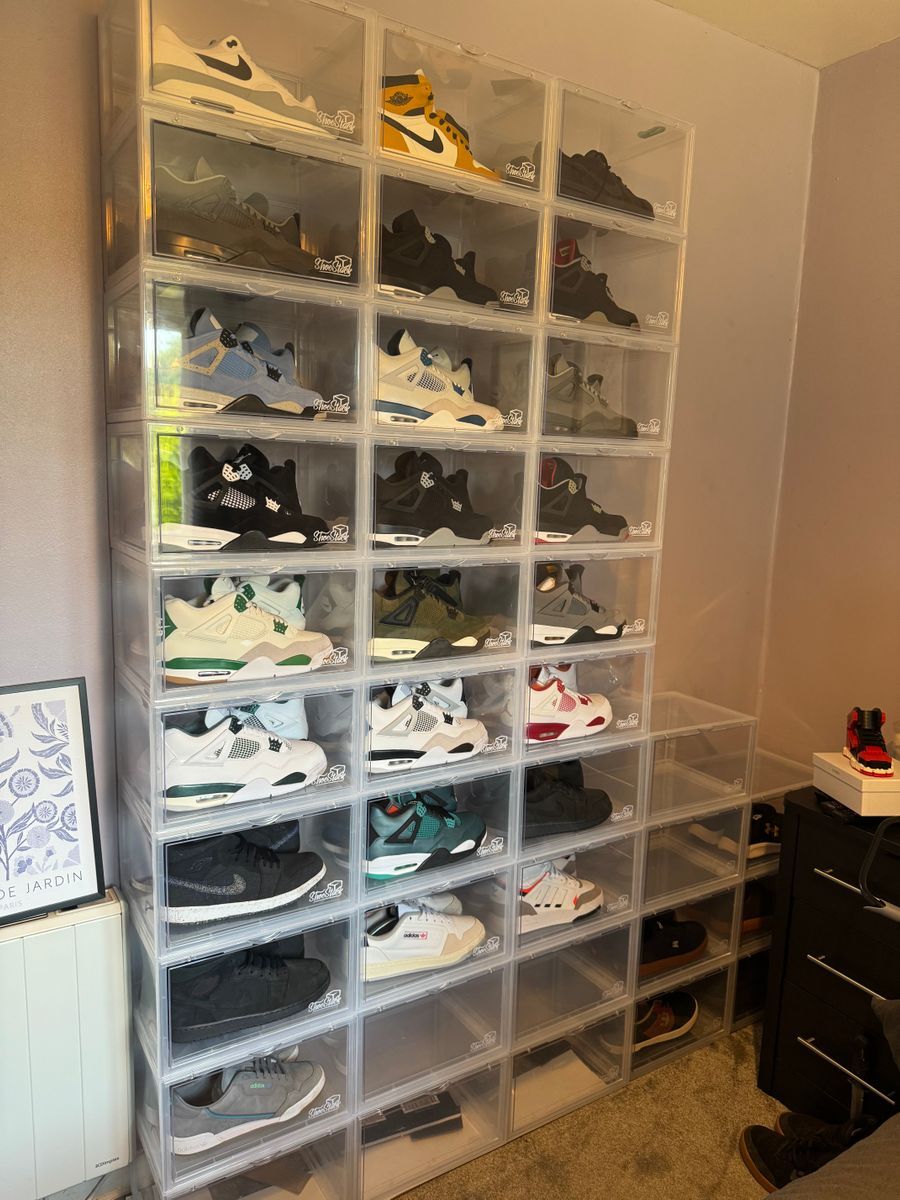
A pile of trainer boxes in the wardrobe looks fine until you need the pair at the bottom. Then it becomes a balancing act, lids slide off, corners crush, and the pair you actually want is still hiding somewhere in the back. That is exactly why drop front shoe boxes have become the go-to upgrade for collectors and organised households alike. They do more than store shoes – they protect them, show them off, and make your setup work properly every day.
Why drop front shoe boxes have taken over
Traditional shoe storage usually forces you to pick one priority. Cardboard boxes protect, but you cannot see what is inside. Open shelving puts everything on display, but leaves your footwear exposed to dust, fading and household mess. Generic plastic tubs are practical enough, yet they often look cheap and make access awkward.
Drop front shoe boxes solve the problem in a more complete way. The front door opens without needing to lift the box above it, so stacked storage stays accessible. That sounds simple, but it changes everything when you have ten, twenty or fifty pairs to manage. You can build upwards, keep the footprint tight, and still reach the pair you want in seconds.
For sneaker collectors, that convenience matters. For anyone who has invested serious money in footwear, it matters even more. Creasing, dust build-up, accidental scuffs and discolouration are all easier to avoid when each pair has its own proper home.
What makes drop front shoe boxes better than standard storage
The real advantage is not one single feature. It is the combination of access, protection and presentation.
A good drop-front design gives you a clear view of your collection, which means less rummaging and less handling. The less you drag pairs in and out of cramped cupboards, the lower the chance of damaging them. That is particularly useful for suede, premium leather, white midsoles and special-edition trainers that do not respond well to rough storage.
Then there is stackability. Proper interlocking boxes create a stable column rather than a wobbly tower of mismatched containers. That lets you use vertical space properly in bedrooms, dressing rooms, box rooms and even hallway cupboards. For homes where space is tight, that alone can justify the switch.
And yes, looks matter. If you have built a collection you are proud of, hiding it in battered retail boxes feels like an afterthought. Drop front shoe boxes turn storage into display. Clean lines, transparent panels and uniform sizing give the whole setup a sharper, more premium finish.
Are all drop front shoe boxes the same?
Not even close.
At a glance, many boxes look similar online. Clear plastic, front-opening panel, stackable shape. But the difference is in the details, and those details decide whether your storage feels solid and premium or flimsy and frustrating.
Door design matters more than people expect
A weak front panel is one of the fastest ways to ruin the experience. If the door sticks, pops open too easily or feels brittle, daily use becomes annoying. Magnetic doors tend to feel more secure and cleaner in use than basic clip closures, especially if you open your boxes regularly.
This is where premium collector-focused designs stand apart. The opening action should feel deliberate, not awkward. You should be able to access a pair quickly without tugging at the whole stack.
Clarity changes the display
If the plastic turns cloudy, scratches easily or gives you a distorted view, the display value drops fast. Clear panels should actually let you see the shoe properly, especially if colourways, silhouettes and details are part of the appeal.
Side-view and front-view options also change the look. Some collectors prefer to showcase the lateral profile of each trainer. Others want a front-facing wall of pairs. It depends on your space and the way you like to display your collection.
Size compatibility is a big deal
Not every pair fits every box. High-tops, chunky runners and larger men’s sizes can be a problem in cheap storage units that look roomy in photos but feel tight in reality. Before buying, it is worth checking internal dimensions and thinking about the biggest pair in your rotation, not just the average one.
If you own a mix of low-tops, boots, heels and bulkier silhouettes, modular systems with interchangeable dimensions make much more sense than random one-off boxes.
Who should buy drop front shoe boxes?
If you own more than a few pairs and care what condition they stay in, you are the target market.
They are an obvious fit for sneaker collectors, but not only sneaker collectors. Fashion footwear, heels, occasion shoes and premium everyday pairs all benefit from being stored individually. Anyone tired of cluttered floors, split cardboard lids or pairs getting dusty at the bottom of a wardrobe will see the appeal straight away.
They are especially useful if your storage needs to work hard visually. In modern homes, bedrooms and dressing areas are often part practical space, part personal showroom. Well-made drop front shoe boxes suit that shift. They keep things tidy without making your collection disappear.
When drop front shoe boxes are worth the extra spend
Cheap storage always looks tempting, especially when you need multiple units. But low-cost boxes often become expensive in the long run because they crack, yellow, collapse under weight or simply fail to fit the shoes you bought them for.
Premium boxes make more sense when your footwear has real value, whether that value is financial or personal. If you are storing limited pairs, designer shoes, favourite everyday trainers or a growing collection, better materials and better construction are not overkill. They are the point.
That said, it depends on what you need. If you just want to hide old gym shoes in the loft, premium display storage is probably unnecessary. If you want daily access, a clean visual setup and proper protection, spending more is usually justified.
What to look for before you buy
The best drop front shoe boxes balance function with presentation. Strong stackability should come first. If the boxes do not lock together securely, the whole system feels temporary.
Material quality is next. You want panels that hold their shape, stay clear and resist wear. Easy assembly matters too, particularly if you are ordering a bundle. Nobody wants to spend an entire evening fighting with flimsy tabs and vague instructions.
Ventilation is worth considering if odour control matters in your home. So is UV protection if your boxes will sit in bright rooms. Not every collection needs LED-lit display cases or fully transparent 360-degree units, but for some setups they are a smart upgrade rather than a gimmick.
If you are buying for scale, consistency matters as much as specs. Uniform sizing across a range makes it easier to expand your setup later without ending up with a mismatched wall of boxes.
Drop front shoe boxes and the display factor
This is the part generic storage misses completely. Good storage should make your space look better, not just less messy.
Drop front shoe boxes work because they create order with very little visual noise. The collection becomes the focal point, not the storage itself. That is why they suit minimalist bedrooms just as well as bold sneaker rooms. Whether you want a subtle stacked column or a full display wall, the format stays clean.
For collectors, display has practical value too. When you can see your pairs clearly, you wear more of your collection. Shoes stop being forgotten at the back of a cupboard. Rotation gets easier. You buy less duplication. Your setup becomes more intentional.
That is also why premium options with magnetic doors, crystal-clear panels and modular compatibility tend to stand out. They are designed for people who are not just storing shoes but curating a collection.
The smart way to build a setup
Most people should not buy shoe storage one box at a time forever. It is usually better to think in zones. Daily wear pairs need the easiest access. Special pairs can sit higher or in dedicated display units. Bulkier shoes may need larger crates, while cleaner low-profile trainers can sit in a more compact run.
Starting with a bundle often makes more sense than piecing everything together gradually, especially if you already know the scale of your collection. It tends to look better, costs less per box and creates a more cohesive result from day one.
If you want your storage to feel upgraded rather than improvised, buy with expansion in mind. A modular system from a specialist brand like ShoeStack makes that easier because the range is built to grow with your collection, not force a full reset later.
A good pair of trainers deserves better than a collapsing cardboard box or a dusty patch of floor. The right storage keeps your collection cleaner, sharper and easier to enjoy – and that is exactly what drop front shoe boxes are supposed to do.
Leave a Reply